Showing posts with label Cooking. Show all posts

Wednesday, January 26, 2011

Kongnamul Korean Soybean Sprout Salad 콩나물

Kongnamul is a very popular side dish for Koreans. It almost always included in the banchan (side dishes) in Korean restaurants. I made this version a couple of days ago and took it to work. The 2 pounds batch was gone by the end of the day. One co-worker really liked it and even put it in the soup she was eating for lunch.


When preparing soybeans for cooking, it's important to pick them over and remove discolored ones and any bean skins that are still hanging on. A traditional Korean mother would snip the skinny tails off of each and every sprout before cooking. Thankfully, this is not usually the case anymore. In fact, the tails have a concentration of an ingredient that is great for hangovers. A very good excuse to be lazy.

Here's a closeup of a few individual sprouts. In her cookbook, Growing Up in a Korean Kitchen, Hi Soo Shin Hepinstall relates how musical notes are called soybean sprout heads by Korean children. It makes perfect sense. Also, it is believed that children who eat a lot of kongnamul will grow up straight and tall.


Here are the ingredients I used for a two pound batch of kongnamul. From left to right - ground sesame seeds, sesame oil, soy sauce, red pepper flakes, black pepper, green onion, salt and garlic.

The sprouts are put in a pot with a cup of boiling water. The sprouts are covered with a lid and cooked on high for about 3 minutes. Do not take the lid off the pot while the sprouts are cooking. Every Korean cook will tell you that the sprouts will taste "off" if the lid is removed too soon.

Drain the sprouts. I usually let them cool a bit also. In the meantime, finely chop the green onions and garlic. Mix with all the other ingredients except for the ground sesame and red pepper flakes.

Sprinkle with the ground sesame and red pepper flakes before serving.

Friday, August 21, 2009

Cooking Korean Style Rice

Rice 밥


One of the best books I purchased on my first trip to Seoul was “An Illustrated Guide to Korean Culture” prepared by the National Academy of the Korean Language. It contains chapters on 233 traditional key words. The first entry in the large food section is Bap 밥, steamed rice. This demonstrates how important rice is to Korean culture. By the way, raw rice is called ssal 쌀 and a rice plant is called byeo 벼. In Korean conversation to “eat bap” is synonymous to “having a meal”. I think this is the logical place to start writing about Korean cooking.

What kind of rice

Basic Korean rice is a medium grain rice that becomes sticky when cooked. In the US, Calrose medium grain rice is a very close substitute for imported Korean rice. It is sold at Costco as the Homai brand and by Rhee Brothers as both the Han Guk Mi and Rhee Chun Rice brands. Homai is what I use at home for everyday meals.

What to use to cook the rice

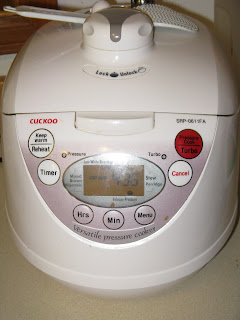
Rice can be cooked in a pot on the stove or using a rice cooker. Rice cookers can be simple and cheap or sophisticated pressure rice cookers that can cost hundreds of dollars. I have two cookers. One is a $30 Aroma model from Costco.


The other is a pressure rice cooker that I received as a gift.

Rice cookers can be very convenient. If you follow the basic instructions for the cooker or on the rice bag, you should be able to produce a good batch of rice without a lot of fuss. On the other hand, it is a useful skill to be able to cook rice well without a special appliance. I’ve been using a regular American style 3 quart pot with a glass lid and a Korean cast aluminum pot gamasot 가마솥 with a black non-stick coating.


Each night for the past week I’ve been making a fresh pot of rice on the stove by cycling through the three different cookbooks mentioned in my previous post. I have made decent rice from each recipe. This is what I did tonight and it produced a very good batch.


My steps to cooking rice on the stove

1) Measure rice into the pot. Two cups will serve two or three people.

2) Run cold water over the rice while swishing it around with your fingers.


3) Tip the pot as needed to drain the water. Be careful not to dump the rice into the sink. Repeat until water is nearly clear.


4) Cover rice with cool water and let soak from 30 to 60 minutes.


5) Drain and cover the rice with the same amount of water as rice. Note: this does not mean the water should be at the same level as the rice in the pot. Two cups of water over two cups of rice will cover the back of your fingers if you gently place your hand flat, palm down, on top of the rice.


6) Cover the rice and bring to a boil on high heat. Stir and cover again.


7) Reduce heat to medium low for 10 minutes and then stir.


8) Reduce heat to low and then cook an additional 10 minutes.


9) Reduce heat to lowest setting and let sit until ready to serve.

This works on my stove but your results may differ. If you have hard rice at the end you should add a little water to the pot and turn up the heat and replace the cover. If the rice is too watery, you should take the lid off and turn up the heat. Stir the rice a bit to help the water evaporate. Try not to disturb the rice at the bottom as by now it has become a little hard. Your rice will improve if you practice and make adjustments to the cooking process.

Wednesday, June 17, 2009

Gamjajeon Korean Potato Pancakes Part 2

I tried again today but used the small holes on the box grater to get away from the "hash brown" look. I also used Yukon Gold instead of Russets. It produced a lot more water which I soaked up with paper towels. The result looked more like a true pancake but they didn't seem to taste as good as the Russet batch. Next time I'll try Russets finely grated. And I'll use my food processor. The box grater and I didn't get along today.


Saturday, July 26, 2008

Japchae 잡채

Here's a picture of the Korean noodle dish Japchae. I made this for a Korean Language Meetup in Seattle. It's considered one of the best Korean dishes to take to a potluck dinner. It can be served at room temperature and keeps well. This version of Japchae contains flank steak, noodles, 3 kinds of mushrooms, onion, carrot, cucumber and bellflower root. It sounds simple but it's fairly labor intensive. All the ingredients are prepared separately and then tossed together at the end. I've made it several times and it's only become a little easier to prepare. I use a mandoline slicer to get the long strips of carrot and cucumber.
Posted by Picasa

Tuesday, June 24, 2008

Shredded Radish Salad 무생채


Mu saengchae is one of my favorite side dishes. I always eat way more than I should and it's easy to make. This picture doesn't convey how spicy this version is. I used plenty of fine red pepper powder along with sugar, Korean brown rice vinegar and salt. I used two large radishes and I think the three of us will have it gone in another day. I use a Japanese mandoline to cut the radish. It makes it easy and looks good too. The recipe doesn't call for any garnishing but it looks naked without at least a sprinkling of sesame seeds for chopped green onion.

Friday, June 20, 2008

Pre-Cut Kimchi 막김치

Considering the cost of kimchi at Paldo, I've started investing the time to make our own kimchi. I made a couple of gallons of cubed radish kimchi a couple of weeks ago and Monday I made just as much cabbage kimchi.
I hadn't made kimchi in about a year so I was a little worried but the recipes I started with were apparently good. The students have eaten about 20% of the cabbage kimchi in two days with a lot of discussion between them about how good it is. At this rate there may not be any left for kimchi jjigae.

My parents picked up 6 heads of cabbage and 2 radishes (about $12) on their way over from Prosser and I already had everything else so it worked out well. I put in the usual cabbage, radish, green onion, garlic, ginger, fish sauce, red pepper and sugar. The only thing different from a lot of recipes was I used fresh shrimp (or thawed Costco shrimp in this case) instead of the salted shrimp I've used in the past. It was important to me to use Costco shrimp because it's not soaked in chemicals like a lot of other seafood.

Friday, May 23, 2008

Shigumchi (Spinach) Namul 시금치나물


I made Shigumchi namul today. It's a Korean side dish that both of my foreign students really like. It's basically blanched spinach that's been wrapped in a towel to dry and then cut into bite size pieces. A soy sauce / sesame oil dressing is then added. Washing the spinach is a bit of a pain but other than that it's an easy way to get tasty vegetables on the table. Sorry for the Ziploc container but that is what functions as a serving dish in my house.

Wednesday, June 13, 2007

Cooking in Advance

I have to go on a short business trip in the near future. Because I'm a homestay host to two international students attending Skagit Valley College, I must prepare dinners in advance of the trip. I have it easy because one guy likes everything and the other guy's favorite dinner is pork ribs. Monday I roasted two slabs of ribs. One was to eat and the other to freeze. I use a spice rub recipe from Jane Butel's "Southwestern Kitchen" and then roast them for 45 minutes at 450. I like them just like that but sauce is OK too.

The dish I made tonight is a Korean chicken dish. I marinate chicken thighs in soy sauce, ginger and garlic for an hour. In the mean time I make a sauce of chopped onions, Korean pepper paste, sugar, vinegar, ketchup (?!) and hot sauce. Brown the chicken and then add the sauce. Cook until done. Not too hard but the result is wonderful. I chill, defat and then freeze. This comes from "A Korean Mother's Cooking Notes" by Chang Sun-Young. I use her recipes a lot.

I'll be happy to provide either recipe.

Saturday, June 2, 2007

Mini kimjang at our house

I’ve always wanted to make kimchi but my sole previous attempt was not successful. A few weeks ago I asked my Korean student, Younsang, to ask one of his fellow Korean students if they would like to come to my house to show me how. A woman whose grandmother is a royal cuisine cook offered to show me how. Other students came along to help. We had a great time making many gallons and quarts of kimchi.

Kimchi is a fermented food that comes from Korea. It is similar to sauerkraut but usually has a lot of red pepper, garlic, ginger and other strong flavorings.

The basic sequence of events is as follows:

Cut and salt the Napa cabbage. Let it soak for several hours to release a lot of water. Younsang and Seungjoon started Saturday evening and looked after the cabbage until after midnight. This is a very important part of the process. Too soon and the cabbage won't ferment properly and too late the cabbage will be very salty.

Rinse the salt out of the cabbage.

Make red pepper/rice flour paste and dump in an oversized bowl.


Prepare additional ingredients including green onions, garlic, ginger, Indian mustard, salted shrimp, fish sauce, fresh oysters and shredded Korean radish.


Add ingredients except cabbage to bowl and mix well.


Set cabbage on top of the mixture and pull down outer leaves. Coat the inside with the mixture. Continue pulling down additional leaves until center is reached.


Squeeze out excess sauce and fold outer leaves over and place in a sanitized jar.

Leave on kitchen counter for 2-3 days and then refrigerate.

Kimchi will slowly become tangier. It can then be used in kimchi fried rice or kimchi stew.

After all the hard work is done, a festive meal is in order. All the students and myself contributed to this table full of Korean food.


If you want to learn more about kimchi here are a couple of links that will provide you with the details of this delicious and unique Korean food.

http://en.wikipedia.org/wiki/Kimchi


http://kimcheedepot.com/aboutkimchee.html

I hope to visit this museum when I’m in Seoul this November:

http://www.kimchimuseum.co.kr/english/information.htm

In addition, I hope to visit the Garak market during Kimjang. Garak is the premier market in Korea.

http://www.visitkorea.or.kr/eng/info_db/shop/shop_detail.jsp?seqno=15

Kimjang is the time when families prepare several months worth of kimchi in order to see them through the winter. It’s becoming less popular because of modern conveniences but it is still a big event.

From what I’ve heard, our kimchi is very much appreciated by the many students who received it.