Monday, January 3, 2011

Korean Seaweed Soup Miyeok Guk 미역국 Pt 1


Here is an easy version of Miyeok Guk.

It includes beef, soy sauce garlic, sesame oil, black pepper, light beef broth and seaweed. Sliced green onions are used to garnish it.
Combine the sliced beef with crushed garlic, soy sauce, 1/2 of the sesame oil and some ground black pepper.

After letting the beef marinate, heat up the other half of the oil in a pot and brown the beef. Add the broth and seaweed and simmer (lightly boil) for up to 15 minutes.
The finished soup is ladled into individual bowls and then garnished with the green onion.
I'll add some cultural and cooking notes with the next post.
Comments are welcome but also moderated.

Thursday, December 2, 2010

Super Pho and Teriyaki - Mount Vernon, WA

I had a nice meal with Paul, my HK student. I'll write more this weekend.

You can click on this or most any other picture to enlarge it.

Wednesday, December 1, 2010

Super Pho and Teriyaki - Mount Vernon, WA

Great news!! A new pho restaurant is opening in the near future. I called today 12/1 and they said it should be open tomorrow. :) It replaces Tokyo Stop on 2nd Street in Downtown Mount Vernon. I'll try it as soon as it's open and give my impressions.


Here's a link to their website with location and menu. I love that they have lots of combos.

http://www.superphoandteriyaki.com/

Tuesday, August 31, 2010

Pho at Thai House - Mount Vernon, WA


The weather turned today. It was cool and very rainy. On the way home I stopped downtown at the Thai House to have a bowl of pho. Of course, pho is a Vietnamese soup, not Thai. I've had their version quite a few times. It's not 100% authentic but it's pretty good and it's the only pho in Mount Vernon (perhaps Skagit County).
Here's a site to learn how to pronounce the word pho. It doesn't rhyme with hoe.

A bowl of pho at Thai House is $8.99. This is a bit more expensive than most pho restaurants. I eat at Pho 99 in Bellingham and their large is $2 or 3$ dollars less.
The lunch specials are a good value. I come here with co-workers every so often. I usually order the phad thai if I'm not getting the pho. My boss and the purchasing manager like the green papaya salad.


The first thing to show up at the table is a plate with Thai basil, jalapeno rings, bean sprouts and a lime wedges. These are all meant to be added to the soup to suit your preference. I always put in the basil and lime juice. Not so much with the bean sprouts and jalapeno.
The sauces are hoisen and sriracha red chili. They are also meant to be added to the broth.


And then the soup shows up. It's a piping hot beef broth with rice noodles, slices of rare beef and garnished with cilantro and sliced green onions.
The broth is seasoned with various spices. The one time I made this with a Vietnamese friend, I remember that we used star anise and ginger that had been charred on a stove top burner.
Add the basil, lime, sprouts, sauces and jalapeno and dig in.

Instead of putting the sauces in the soup, I learned a custom from a northern Viet student who had learned the custom in turn from southern Viet students. I mix the sauces on a plate and dip the meat in it.
In a pho restaurant, the slices of eye of round are just one of the choices. I usually get a combination that includes round steak, tendon, tripe and then some fatty, well cooked beef.

Monday, August 30, 2010

Tacos Tecalitlan 3 - Mount Vernon, WA

This taco truck is behind a smoke shop just down the block from the Grocery Outlet. I had four tacos and a pop for about $7. I had one each of the tripa, buche, chicharrone and carnitas.

The woman working the counter knew just enough English to take my order but not to tell me what buche was other than it was pork. No problem. I'm advernterous. I enjoyed all four.


Posted by Picasa

Friday, August 21, 2009

Cooking Korean Style Rice

Rice 밥


One of the best books I purchased on my first trip to Seoul was “An Illustrated Guide to Korean Culture” prepared by the National Academy of the Korean Language. It contains chapters on 233 traditional key words. The first entry in the large food section is Bap 밥, steamed rice. This demonstrates how important rice is to Korean culture. By the way, raw rice is called ssal 쌀 and a rice plant is called byeo 벼. In Korean conversation to “eat bap” is synonymous to “having a meal”. I think this is the logical place to start writing about Korean cooking.

What kind of rice

Basic Korean rice is a medium grain rice that becomes sticky when cooked. In the US, Calrose medium grain rice is a very close substitute for imported Korean rice. It is sold at Costco as the Homai brand and by Rhee Brothers as both the Han Guk Mi and Rhee Chun Rice brands. Homai is what I use at home for everyday meals.

What to use to cook the rice

Rice can be cooked in a pot on the stove or using a rice cooker. Rice cookers can be simple and cheap or sophisticated pressure rice cookers that can cost hundreds of dollars. I have two cookers. One is a $30 Aroma model from Costco.


The other is a pressure rice cooker that I received as a gift.
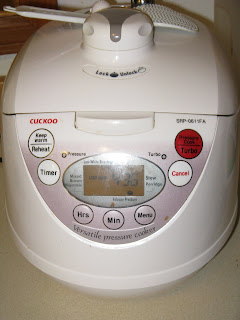
Rice cookers can be very convenient. If you follow the basic instructions for the cooker or on the rice bag, you should be able to produce a good batch of rice without a lot of fuss. On the other hand, it is a useful skill to be able to cook rice well without a special appliance. I’ve been using a regular American style 3 quart pot with a glass lid and a Korean cast aluminum pot gamasot 가마솥 with a black non-stick coating.


Each night for the past week I’ve been making a fresh pot of rice on the stove by cycling through the three different cookbooks mentioned in my previous post. I have made decent rice from each recipe. This is what I did tonight and it produced a very good batch.


My steps to cooking rice on the stove

1) Measure rice into the pot. Two cups will serve two or three people.

2) Run cold water over the rice while swishing it around with your fingers.


3) Tip the pot as needed to drain the water. Be careful not to dump the rice into the sink. Repeat until water is nearly clear.


4) Cover rice with cool water and let soak from 30 to 60 minutes.


5) Drain and cover the rice with the same amount of water as rice. Note: this does not mean the water should be at the same level as the rice in the pot. Two cups of water over two cups of rice will cover the back of your fingers if you gently place your hand flat, palm down, on top of the rice.


6) Cover the rice and bring to a boil on high heat. Stir and cover again.


7) Reduce heat to medium low for 10 minutes and then stir.


8) Reduce heat to low and then cook an additional 10 minutes.


9) Reduce heat to lowest setting and let sit until ready to serve.

This works on my stove but your results may differ. If you have hard rice at the end you should add a little water to the pot and turn up the heat and replace the cover. If the rice is too watery, you should take the lid off and turn up the heat. Stir the rice a bit to help the water evaporate. Try not to disturb the rice at the bottom as by now it has become a little hard. Your rice will improve if you practice and make adjustments to the cooking process.

Friday, August 14, 2009

Korean cooking from the beginning

For now I will start preparing recipes from my three favorite Korean cookbooks. I will be comparing and contrasting them as I expand my knowledge of Korean food. I will do my best to pass along what I’ve learned and the little tips that I already know. What I won’t be doing is giving you the entire recipes verbatim from the books. You should buy these cookbooks. The authors went to an incredible amount of work to get published these books and we should support them by purchasing the fruits of their very hard labor. I own at least three copies of each. If I have a recipe that is original to me, I will include it in its entirety.

The following books will be my reference materials along with quite a few other cookbooks and Korean food and culture books. These three are very worthy purchases:

http://www.amazon.com/Korean-Mothers-Cooking-Notes/dp/8973002996

http://www.amazon.com/Growing-up-Korean-Kitchen-Cookbook/dp/1580082815

http://www.amazon.com/Eating-Korean-Barbecue-Kimchi-Recipes/dp/0764540785/

I’m not recommending Amazon as the source of the books but it’s a good starting place to learn about them. Here is another link to A Korean Mother’s Cooking Notes http://www.hanbooks.com/kormotcookno.html with more information.

The next post will be about Korean style rice.